
BASEMENT WATERPROOFING * SANDUSKY, OH
Exterior Waterproofing & French Drains in Sandusky, OH
Exterior waterproofing is the only approach that stops water before it reaches your foundation rather than managing it after it arrives. We excavate down to the footing, clean and repair the wall, apply a waterproof membrane and drainage board, and bed perforated pipe in washed stone to carry water away. It costs more than interior drainage because of the digging, and it is the right choice in specific situations rather than all of them — we will tell you honestly which one you are in.
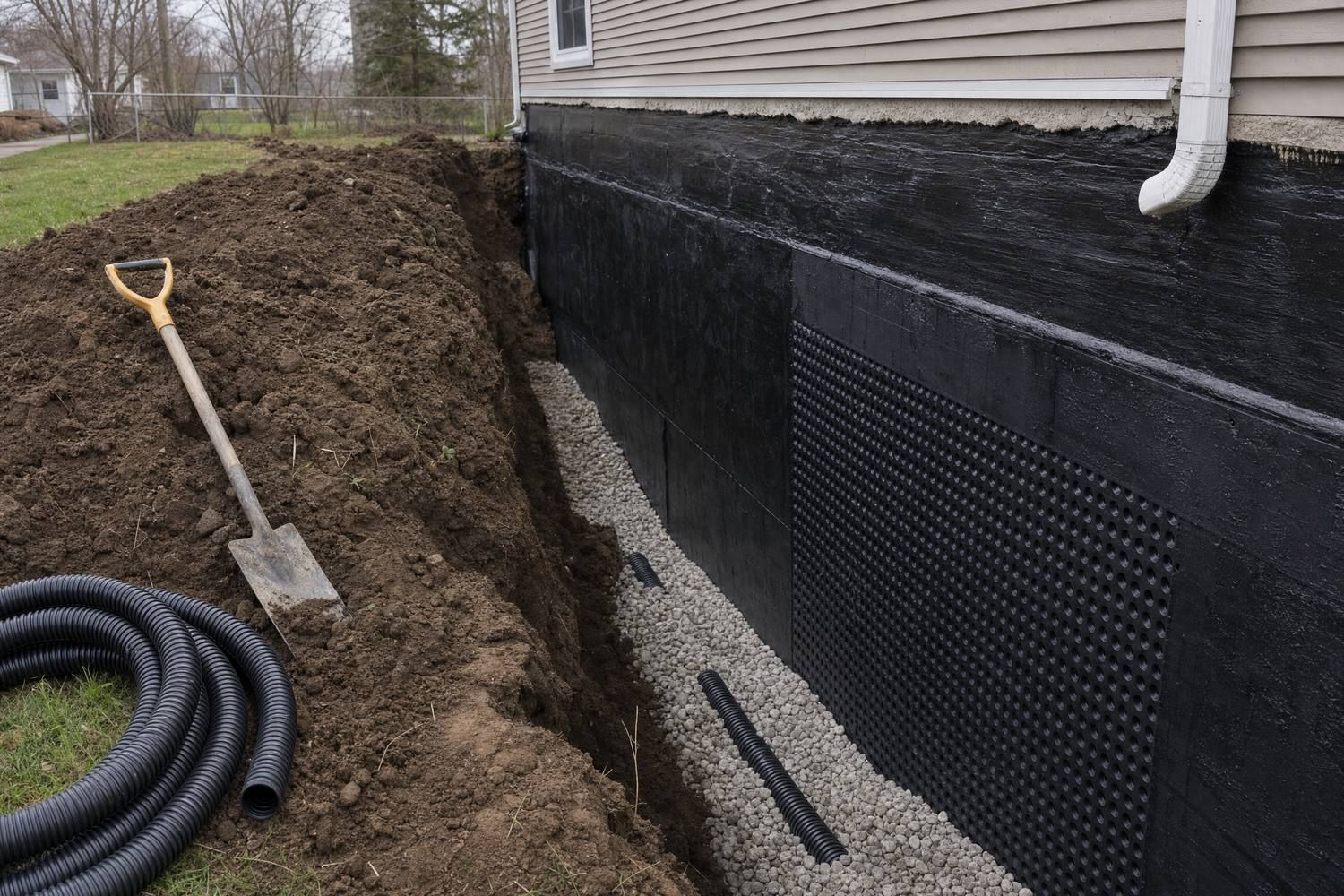
What exterior waterproofing and a French drain involve
We excavate along the affected elevation down to the top of the footing, which on a Sandusky basement usually means seven to eight feet of depth. The wall face is cleaned of soil and old coatings, any cracks or failed mortar joints are repaired, and then a waterproof membrane is applied across the full below-grade surface. Over the membrane goes a dimpled drainage board, which creates an air gap so any water reaching the wall runs down it freely rather than sitting against the foundation under pressure.
At the footing we lay perforated pipe — the French drain proper — bedded in washed stone and wrapped in filter fabric so soil cannot migrate in and silt it up. That pipe is graded to run to daylight where the site allows, or to a legal discharge point where it does not. The excavation is then backfilled, ideally with free-draining granular material for the first foot or so against the wall rather than the clay that came out, because putting the clay straight back recreates the water-holding condition we just spent three days fixing. We finish by grading the surface to fall away from the house and, where needed, extending downspouts to discharge beyond the backfill zone.
When exterior waterproofing is the right choice: signs and situations
Exterior work is the correct answer in these situations, and often the only one that will hold:
- Water entering through the wall itself at multiple points, not up through the floor joint
- A finished basement where you cannot cut the floor for interior drainage without destroying the finishes
- A stone or block wall so porous that the whole elevation transmits moisture rather than one spot
- Efflorescence and damp across a broad area of wall rather than tracking from a single crack
- Interior drainage already installed by someone else and water still coming through the wall above it
- Backfill that has settled into a trough against the foundation, channelling roof and surface water straight down the wall
Get Your Free Quote
Why exterior water pressure builds against Sandusky foundations
The soil around most Sandusky houses is clay, which holds water rather than shedding it. Rain saturates the backfill against the foundation, and because clay drains slowly that water stays there, applying hydrostatic pressure against the wall for days after the storm has passed. Add Ohio's freeze-thaw cycling and the pressure becomes mechanical as well as hydraulic. Most below-grade walls in older houses were built with a coat of tar or nothing at all — that was normal practice at the time, and it is not waterproofing by any modern standard.
Two things commonly make it worse, and both are fixable. The first is backfill settlement: the soil put back after the house was built compacts over decades and forms a shallow trough against the wall, which then collects roof runoff and delivers it directly to the foundation. The second is downspout discharge. A single downspout dumping at the corner of the house puts an enormous volume of water into exactly the wrong place, and we see it constantly. Both of those can produce a basement that only leaks during heavy rain — and if that describes yours, the fix may be far cheaper than excavation, which is why we look outside before quoting anything.
What affects the cost of exterior waterproofing in Sandusky
This is our most expensive service and the excavation is why. The number depends on:
- Linear feet of wall excavated — treating one elevation costs a fraction of going all the way round
- Depth to the footing, since a full basement means seven to eight feet of excavation
- Obstructions — decks, porches, driveways, patios, mature trees, and utility lines all add cost
- Machine access, because a site a mini-excavator can reach costs far less than one dug by hand
- Whether the work touches a city right-of-way, which requires a permit and licensed contractor
- Discharge routing — running to daylight is cheapest, a legal tie-in or dry well costs more
Interior drainage or exterior waterproofing — how to decide
The deciding question is where the water crosses into the basement. If it comes up through the floor or the floor-wall joint, that is groundwater under the slab and interior drainage handles it at a fraction of the cost — excavating the outside would be spending several times more to solve a problem the interior system solves properly. If water comes through the wall itself, especially at several points or across a broad area, interior drainage only collects it after it is already inside your masonry. It manages the symptom, and on a porous stone wall the wall stays wet.
Cost and disruption pull in opposite directions and that is worth saying plainly. Interior work means concrete dust, a saw running indoors, and a patched floor. Exterior work means your yard opened up, plantings and possibly a patio disturbed, and a bigger bill — but nothing inside the house is touched, which is decisive if the basement is finished. There is also a middle path we use often: exterior treatment of the one elevation actually taking water, combined with interior drainage elsewhere. That is usually the best value on a Sandusky house, and it only comes out of an inspection that looks at both sides of the wall.
Our step-by-step exterior waterproofing process
- STEP 1
Free on-site inspection inside and out — grade, downspouts, backfill settlement, and where water actually enters
- STEP 2
Utility locate and written fixed-price quote including permits, spoil handling, and restoration
- STEP 3
Permits pulled by us — right-of-way permit where excavation touches city property, flood plain permit where the address requires one
- STEP 4
Site protection — plantings lifted where they can be saved, access route matted, spoil stockpiled clear of the trench
- STEP 5
Excavation to the top of the footing along the affected elevation
- STEP 6
Wall cleaned, cracks and mortar joints repaired, waterproof membrane applied, drainage board fitted over it
- STEP 7
Perforated French drain pipe bedded in washed stone with filter fabric, graded to a legal outfall
- STEP 8
Backfill with free-draining material against the wall, surface graded to fall away, downspouts extended, site restored
Timeline and what to expect during excavation
Three to six days for a single elevation on a typical Sandusky house, longer if we are going round more than one side. Day one is locates, setup, and the start of excavation. Days two and three are wall preparation, membrane, drainage board, and pipe. The final day or two is backfill, grading, and restoration. Your yard will be genuinely disrupted along the work line for that period and there will be a machine and a spoil pile on site. Weather governs the schedule more than anything else — we will not backfill against a membrane in heavy rain, and if a storm sits over Erie County mid-job we stop and secure the trench rather than rush it.
GOOD TO KNOW
FAQs
Is exterior waterproofing better than interior drainage?
It is better at stopping water, because it works before the water reaches your foundation instead of collecting it afterward. But it is not automatically the right choice. If water is coming up through the floor rather than through the wall, interior drainage solves that properly for far less money and excavating outside would be wasted spending. Exterior is the right answer when water comes through the wall itself, when the basement is finished and cannot be cut, or when a stone wall is porous across a whole elevation.
How much of my yard will you dig up?
A trench roughly three to four feet wide along the elevation we are treating, down to the footing — usually seven to eight feet deep. Plantings in that line have to come out, and we will lift and hold anything worth saving. A patio, deck, or driveway crossing the work line has to be cut and reinstated, and that gets priced in the quote rather than discovered later. We mat the access route so the machine does not wreck the rest of the lawn.
Do I need a permit for exterior waterproofing in Sandusky?
Usually yes, and often more than one. Excavating in a city right-of-way requires a permit and can only be done by a licensed contractor. Where the drain discharges into a storm or sanitary lateral, a Sandusky sewer permit is required for the installation, repair, or replacement of that lateral. If your property is in a mapped flood plain area, a flood plain permit must be issued before a building permit. We pull all of them and include the cost in our number.
Can you fix my problem without excavating at all?
Sometimes, and we always check. If your basement only leaks during heavy rain, the cause is often surface water rather than groundwater — a downspout discharging against the foundation, or backfill that has settled into a trough collecting roof runoff. Correcting the grade and extending the downspouts can solve that for a very small fraction of an excavation, and if that is what we find, that is what we will tell you.
What do you backfill with, and why does it matter?
Free-draining granular material against the wall rather than the clay that came out of the trench. This is one of the details that separates a lasting job from one that fails in five years. Clay backfill holds water against the foundation and recreates the exact hydrostatic pressure the membrane was installed to defeat. Granular backfill lets water reach the French drain and leave. It costs a little more in material and it is not optional in our specification.
Stop water before it reaches your foundation
Book a free on-site inspection. We look at the grade, the downspouts, and the wall from both sides, then tell you whether you need excavation or something far simpler.