
BASEMENT WATERPROOFING * SANDUSKY, OH
Interior Drainage & Sump Pumps in Sandusky, OH
An interior perimeter drainage system with a sealed sump pump is the standard solution when groundwater rises against your footing and pushes up through the floor joint. We cut a channel around the inside perimeter of the basement floor, bed perforated pipe in washed stone, and route it to a sealed basin that discharges well away from the house. It is also the most over-sold service in this trade, so we say this plainly: if your water enters at one crack in the wall, you do not need this system, and we will tell you that during the inspection.
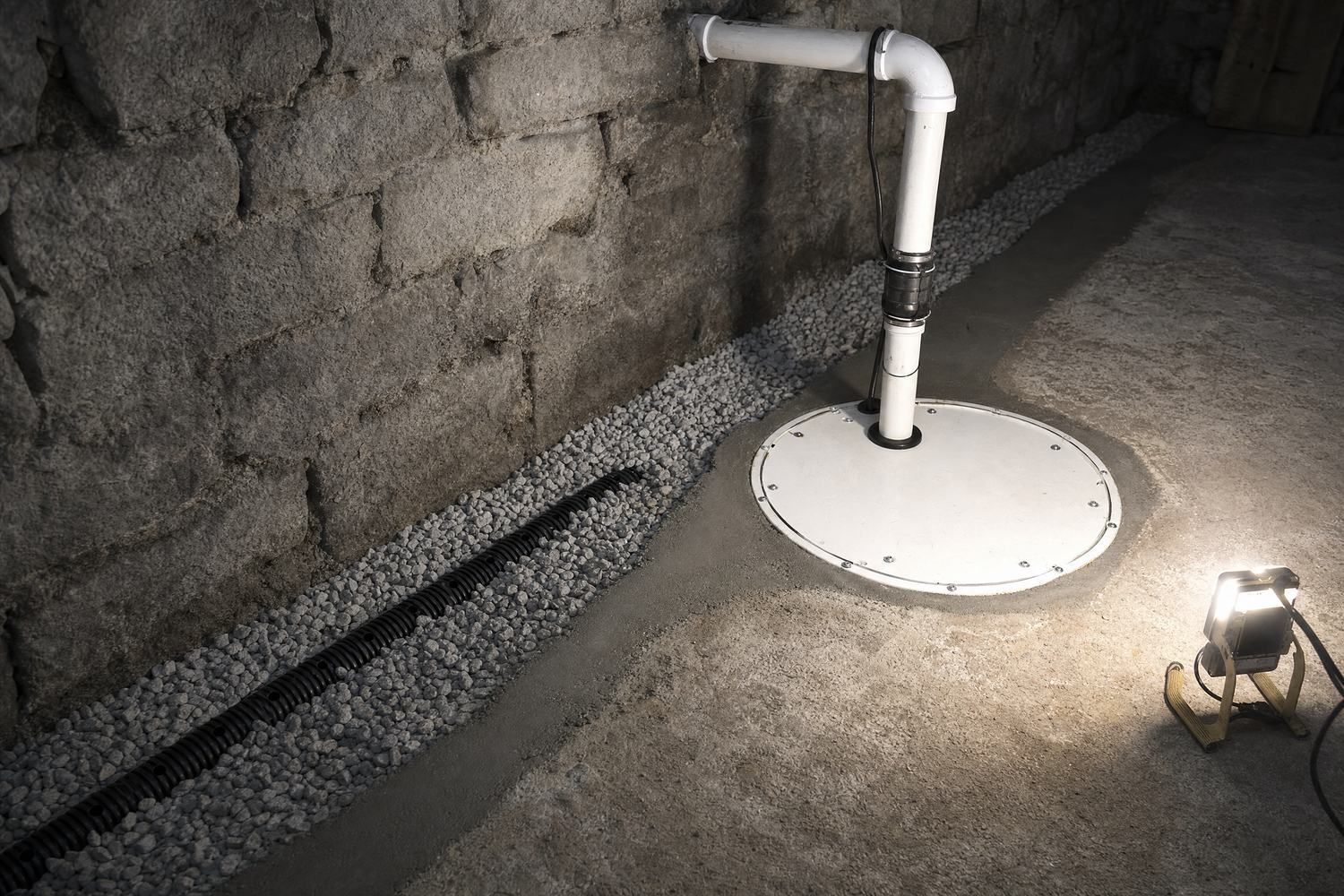
What an interior drainage and sump pump system involves
We break out a channel of concrete roughly twelve inches wide around the inside perimeter of the basement, down to the level of the footing. Perforated pipe goes in bedded in washed stone — never in soil or sand, which silts up within a few years — and the stone is wrapped in filter fabric. Where the wall meets the floor we install a drainage membrane so water running down the inside face of the wall is captured rather than spilling onto the slab. The pipe runs to a sump basin set into the floor at the low point, and we finish with new concrete over the channel.
The basin gets a sealed lid, not an open pit. This matters and it is where a lot of installed systems fall short. A sealed lid with a gasketed pipe penetration keeps soil gas and humidity out of your basement air and stops the basin acting as an evaporation pan. We fit a cast-iron or heavy-duty thermoplastic pump sized to the water volume, a check valve on the discharge so the column of water in the pipe does not drop back into the basin each cycle, and a discharge line taken well clear of the foundation. Where the basement sits below street level we recommend a battery backup pump, because the storms that flood Sandusky basements are the same storms that take the power out.
When you need interior drainage: signs and situations
Interior drainage is the right answer when water is coming up rather than in. Look for these:
- Water appearing along the joint where the floor meets the wall, rather than from a crack higher up
- Damp patches or seepage in the middle of the basement floor
- Water that arrives a day or two after heavy rain rather than during it — groundwater rising, not surface runoff
- An existing sump pump that runs constantly in wet months, or cannot keep up during a storm
- White chalky efflorescence along the base of the walls, showing water is moving through the masonry
- A finished basement you want to protect before installing flooring, drywall, or storage
Get Your Free Quote
Why groundwater pushes into Sandusky basements
Sandusky sits on the Lake Erie shoreline over clay soils that drain slowly, and the water table here is naturally high. Ohio's Department of Natural Resources states plainly that a high water table is unsuitable for basements, which describes a great deal of this city's housing stock. When rain saturates clay that cannot shed it, the water has nowhere to go and builds hydrostatic pressure against your footing and slab. Concrete is not waterproof under pressure, so it comes up through the floor joint and any crack in the slab.
Rainfall intensity is making this worse. On July 6, 2026, Kelleys Island took ten to fifteen inches of rain, peaking at five inches an hour, and one homeowner reported their sump pump moving 36,000 gallons overnight and still running the next morning. A system sized for the storms of twenty years ago is undersized for these. There is also a cause specific to older in-town Sandusky houses: many have a perimeter foundation drain tied directly into the municipal storm sewer. That is permitted here, but when the storm sewer surcharges and your floor sits below street level, city water can push backward through the drain into the house. If that is what is happening, a bigger pump will not fix it — a backwater valve will, and we check for this before quoting.
What affects the cost of interior drainage in Sandusky
We quote one fixed itemised figure after the inspection. These are the factors that move it:
- Linear feet of perimeter treated — a partial run along the wet wall costs considerably less than a full loop
- Concrete thickness and whether there is reinforcing mesh or rebar to cut through
- Pump specification — a basic thermoplastic unit versus cast iron, and whether a battery backup is included
- Discharge routing — how far the line must run to reach a safe outfall away from the foundation
- Whether a backwater valve is needed because the foundation drain ties into the city storm sewer
- Access and obstructions — a finished basement, a boiler, or built-in shelving all add labour
Spot repair or full perimeter system — how to decide
This is the decision where homeowners get sold the most unnecessary work, so here is the honest version. If water enters at one identifiable point, a single crack, a rod hole, a gap around a pipe penetration — the correct fix is sealing that point, and it costs a few hundred dollars rather than several thousand. If the water only ever appears during heavy rain and never otherwise, the cause is usually surface water, and correcting a downspout that discharges against the foundation or regrading soil that slopes toward the house solves it for almost nothing. We will tell you when that is the situation.
A full perimeter system earns its cost when water enters at several points along the wall, when it comes up through the floor or the floor-wall joint rather than through the wall itself, when the water table genuinely rises above your slab in wet months, or when you are about to finish the basement and cannot risk it. Partial systems are also legitimate: if only the lake-facing wall takes water, we can run drainage along that elevation alone. That is a real saving, and it is not something a franchise selling one standard package will offer you.
Our step-by-step interior drainage installation process
- STEP 1
Free on-site inspection — we assess inside and out, check the grade and downspouts, and trace where your foundation drain actually discharges
- STEP 2
Written diagnosis and fixed itemised quote, including permits and the timeline
- STEP 3
Permits pulled by us — a Sandusky sewer permit where the discharge ties into a lateral, and a flood plain permit if your address requires one
- STEP 4
Protection and setup — floors and stairs covered, dust containment, and slurry contained rather than spread through the house
- STEP 5
Concrete cut and removed around the perimeter, and the sump basin excavated at the low point
- STEP 6
Perforated pipe bedded in washed stone with filter fabric, wall membrane installed at the floor-wall joint
- STEP 7
Sealed sump basin, pump, check valve, and discharge line routed clear of the foundation — battery backup fitted where specified
- STEP 8
New concrete poured, inspection attended, water test run with you watching, site cleaned, and warranty documentation handed over
Timeline and what to expect during installation
A typical Sandusky basement takes two to four days. Day one is cutting and removing concrete, which is the loud, dusty part — expect a concrete saw running for several hours. Day two is pipe, stone, membrane, and the sump basin. Day three is the concrete pour, and the new slab needs 24 to 48 hours before you walk on it and about a week before you place anything heavy. Add a day for a full perimeter in a larger house, or where a finished basement has to be opened up and closed back. You will have water and power throughout, and we work around your boiler and laundry rather than shutting them off.
GOOD TO KNOW
FAQs
How long does an interior drainage system take to install in Sandusky?
Two to four days for most Sandusky basements. Day one is concrete removal, day two is pipe and stone and the sump basin, day three is the pour. The new concrete needs 24 to 48 hours before foot traffic. Larger houses or finished basements that must be opened up add a day.
Do I need a permit for a sump pump discharge in Sandusky?
Often yes. The City of Sandusky requires a sewer permit for the installation, repair, or replacement of any storm or sanitary lateral, and only a licensed contractor can pull one. Where the discharge crosses a city right-of-way, that needs a permit too. If your property sits in a mapped flood plain area, a flood plain permit has to be issued before a building permit. We handle all of it and the cost is in our quote.
Why does my sump pump run when it has not rained?
Usually a genuinely high water table, which is common across Sandusky given the clay soils and the lake. But it can also mean the pump's check valve has failed, so the water in the discharge pipe drops back into the basin and the pump cycles on the same water repeatedly. That shortens the pump's life considerably and it is a cheap fix. Worth having looked at before anybody sells you a new system.
Do I need a battery backup pump?
If your basement is below street level or finished, yes. The storms that overwhelm Sandusky basements are the same storms that take the power out, and a pump without backup is offline exactly when it is needed most. On a July 2026 storm one local homeowner's pump moved 36,000 gallons overnight; had the power failed, the basement would have flooded regardless of how good the system was.
Will the new concrete match my existing floor?
The colour will differ — new concrete cures lighter and no patch matches a floor that has aged for decades. The finish will be smooth and level with the surrounding slab so it is sound and easy to cover. If you plan to seal or paint the floor afterward, tell us and we will finish it to suit.
Stop water coming up through your floor
Book a free on-site inspection. We find out whether you need a full perimeter system or a much smaller repair, and give you one fixed price in writing.