
BASEMENT WATERPROOFING * SANDUSKY, OH
Foundation Crack Repair in Sandusky, OH
We repair leaking foundation cracks in both poured concrete and the limestone walls Sandusky has more of than any other city in Ohio. Those two walls fail in completely different ways and need completely different repairs. Poured concrete cracks, and the fix is a polyurethane resin injected under pressure through the full thickness of the wall. Limestone laid in lime mortar does not crack — it weeps through eroded joints, and injection accomplishes nothing at all. If a company has quoted you injection on a stone foundation, they have not looked at your wall.
What foundation crack repair involves
On a poured concrete wall we inject the crack rather than patch its surface. Injection ports are fitted along its length, the face is sealed, and a polyurethane resin is pumped in under pressure until it emerges at the next port, which confirms it has travelled the full depth of the wall. The resin expands and stays flexible, so it moves with seasonal expansion instead of cracking straight back open. Surface patching with hydraulic cement, which is what most DIY attempts amount to, seals only the inside face and leaves water still tracking through the wall behind it.
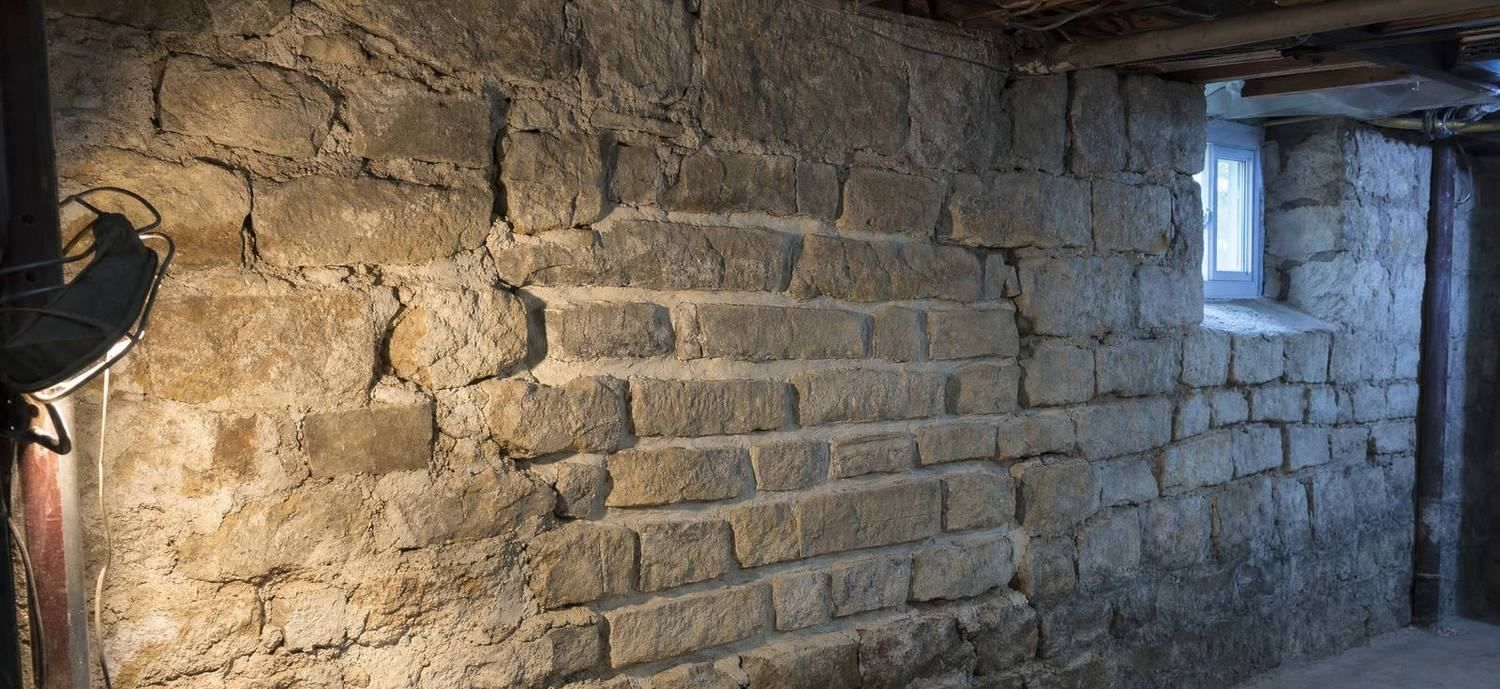
A limestone or rubble stone foundation needs an entirely different approach. Water passes through mortar joints that have eroded and washed out over decades, not through a single crack, so there is nothing to inject. The repair is repointing: raking out the failed mortar to sound material and refilling with a lime-compatible mortar. The mortar specification is critical. Modern portland cement is harder than the limestone around it, so it traps moisture in the stone and causes the stone face to spall and break away — a repair that destroys the wall it was meant to fix. On larger areas we combine repointing with a wall membrane and interior drainage, because a stone wall will always transmit some moisture.
When you need foundation crack repair: signs and situations
Not every crack leaks, and not every crack is structural. These are the ones to act on:
- A visible crack that darkens, weeps, or drips during or after rain
- A crack that is wider at one end than the other, or wider than it was last year
- White chalky efflorescence tracking down the wall from a crack, showing water is passing through
- Mortar joints in a stone or block wall that have washed out to a recess you can put a finger into
- Crumbled mortar dust collecting on stone ledges or on the floor below the wall
- Damp or staining around a rod hole, pipe penetration, or where a poured wall meets the footing
Get Your Free Quote
Why foundation cracks and mortar failure happen in Sandusky
Sandusky's clay soils are the underlying cause of most of it. Clay expands when it takes on water and contracts as it dries, and that cycle applies pressure against the foundation wall from outside, then releases it. Repeat that through enough Ohio winters and a poured wall develops vertical or diagonal cracks, usually starting at a corner, a window opening, or a rod hole where the wall is already weakest. Freeze-thaw makes it worse: water sitting in a hairline crack expands as it freezes and widens the crack a fraction every winter.
Stone foundations fail differently, and Sandusky has an unusual number of them. This city holds the largest collection of limestone buildings in Ohio, quarried locally and laid in lime mortar. Lime mortar was designed to be softer than the stone, so it absorbs movement and can be replaced — that was intentional, not a defect. But over a century of water passing through, the mortar erodes and washes out until the joints are open channels. Nothing has cracked. The wall is simply porous where the mortar used to be. Any repair that treats it as a crack, or repoints it with hard modern cement, either does nothing or actively damages the limestone.
What affects the cost of foundation crack repair in Sandusky
Crack repair is the least expensive service we offer. These are the factors that move the number:
- Wall type — polyurethane injection on poured concrete versus lime-mortar repointing on stone
- Number and length of cracks, or linear feet of mortar joint needing raking out and refilling
- Wall thickness, since a thicker wall takes more resin to fill through its full depth
- Whether the crack is structural, which needs carbon fibre or steel reinforcement rather than sealing alone
- Access — an exposed wall versus one behind finished drywall, shelving, or a boiler
- Whether a membrane and drainage are added, which is common on stone walls and rare on poured
Sealing, reinforcing, or rebuilding — how to decide
Most leaking cracks only need sealing. A vertical or diagonal crack in a poured wall that is not displaced — meaning the two sides are still in the same plane — is a water problem, not a structural one, and injection resolves it permanently for a few hundred dollars. The same logic applies to a rod hole or a pipe penetration. This is the honest answer for the large majority of cracks we are called out to look at, and it is worth knowing before you accept a quote for a full drainage system on the strength of one crack.
Reinforcement becomes necessary when there is displacement: one side of the crack sits proud of the other, the crack is horizontal, or the wall is visibly bowing inward. Horizontal cracks in particular indicate lateral soil pressure and need carbon fibre straps or steel bracing, not just sealing. On stone walls, repointing is the standard repair and rebuilding is rare — but if a section has lost so much mortar that stones have shifted or dropped, that section has to be taken down and relaid. We will tell you which of these you have and show you what we are looking at, rather than describing it over the phone.
Our step-by-step foundation crack repair process
- STEP 1
Free on-site inspection — we identify the wall type first, because poured concrete and limestone need different repairs
- STEP 2
Assessment of whether the crack is a water problem or a structural one, checked for displacement and bowing
- STEP 3
Written diagnosis and fixed itemised quote, with the repair method stated explicitly
- STEP 4
Surface preparation — the crack or joint is cleaned back to sound material, loose mortar and debris removed
- STEP 5
On poured walls: injection ports fitted along the crack and the face sealed
- STEP 6
Polyurethane resin injected under pressure until it emerges at the next port, confirming full-depth travel
- STEP 7
On stone walls: joints refilled with lime-compatible mortar, tooled to match the existing profile — never portland cement
- STEP 8
Cure, water test with you watching, site cleaned, and written warranty on the treated area
Timeline and what to expect
A single crack injection is a few hours, and you can use the basement the same day. Several cracks in one visit is still usually a single day. Repointing a stone wall takes longer because the work is done by hand — a modest section is a day, a full wall elevation two to three days, and lime mortar needs to cure slowly and be kept damp rather than dried quickly, so we will ask you not to run a dehumidifier against a freshly repointed wall for the first week. Where we are adding a membrane and drainage to a stone wall, allow three to five days in total.
GOOD TO KNOW
FAQs
Can you inject a crack in a stone foundation?
No, and this is the single most common mistake made on Sandusky houses. A limestone or rubble stone foundation laid in lime mortar does not have a crack to inject — water passes through mortar joints that have eroded along their length. Injection has nothing to fill and nowhere to travel. The correct repair is raking out the failed mortar and repointing with a lime-compatible mix. If someone has quoted you injection on a stone wall, they have not inspected it properly.
Is my crack structural or just leaking?
The test is displacement. If both sides of the crack are still in the same plane and the crack is vertical or diagonal, it is almost certainly a water problem and sealing it is the whole repair. If one side sits proud of the other, the crack is horizontal, or the wall is bowing inward, that is lateral soil pressure and needs carbon fibre or steel reinforcement first. We check this during the inspection and show you what we are seeing.
Why can't you use regular cement to repoint my stone foundation?
Because modern portland cement is harder than Sandusky limestone. Lime mortar was deliberately made softer than the stone so that movement and moisture pass through the mortar, which can be replaced, rather than through the stone, which cannot. Repoint with hard portland mix and moisture gets trapped in the stone instead, and the stone face spalls and breaks away. It looks like a tidy repair for a couple of years and then does permanent damage.
Will an injected crack open up again?
Not if it is done properly. Polyurethane resin stays flexible after curing, so it accommodates the seasonal expansion and contraction that Sandusky's clay soils cause. That flexibility is the point, and it is why we do not use a rigid epoxy for water-only repairs. What does fail is surface patching with hydraulic cement, which seals the inside face while water keeps tracking through the wall behind it.
Do I need drainage as well as crack repair?
On a poured concrete wall with one or two leaking cracks, usually not — sealing the cracks is the whole job. On a stone foundation it is a fair question, because a stone wall will always transmit some moisture even after good repointing. Where the wall is large or the basement is finished, we often recommend repointing plus a wall membrane and interior drainage. We will tell you if repointing alone is enough.
Get your foundation crack looked at properly
Book a free on-site inspection. We identify what your wall is actually made of before recommending a repair, and give you a fixed price in writing.